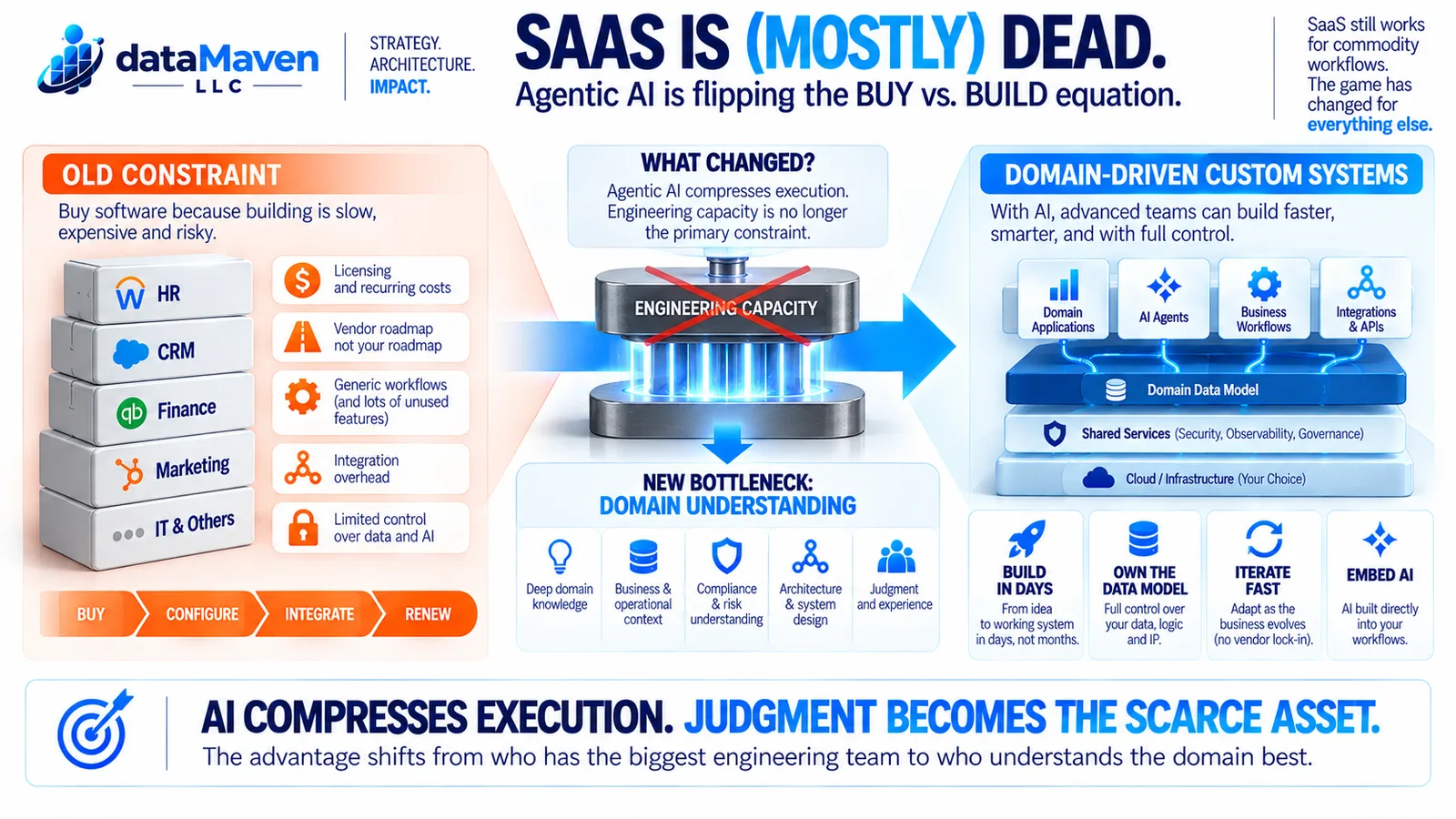
For the last 15 years, SaaS has dominated enterprise technology. Need a CRM? Buy it. Need an integration layer? Subscribe. Need analytics? License it. The playbook was simple: Buy → Configure → Integrate → Renew.
But something fundamental has shifted.
The old constraint: engineering capacity
Historically, custom software was expensive not because ideas were hard — but because engineering bandwidth was scarce.
Take one application:
- Three-year roadmap
- 20,000+ lines of code
- Mounting technical debt
- A feature backlog growing faster than delivery
Sound familiar?
At Octave, our internal data-operations framework had evolved over three years into a powerful but complex system:
- Multi-source ingestion (S3, Google Drive, SFTP, APIs)
- Replication logic
- Data de-identification
- Layered change data capture with fallback options
- QuickSight automation
- Slack operational telemetry
- Gated job orchestration
- Production-grade controls for compliance
It worked. But it carried technical debt. The UI lagged behind. Certain complex features stayed “on the roadmap.”
Rebuilding it from scratch would traditionally be a multi-quarter, 5+ engineer initiative. Instead, I decided to push agentic AI and re-develop it from the ground up. It took as little as one week, as a side project, to complete.
20,000 lines of code. Rebuilt.
With agentic AI as a development partner, I:
- Re-architected the core framework
- Eliminated accumulated technical debt
- Overhauled the UI completely
- Simplified orchestration logic
- Refactored job gating and metadata handling
- Added previously deferred complex features
- Improved observability and operational rollups
- Reduced cognitive load across the entire system
This wasn’t copy/paste generation. It was an iterative, architectural collaboration.
The difference? AI handled the:
- Boilerplate
- Refactoring at scale
- Pattern consistency
- Structural rewrites
- Documentation
- Test scaffolding
- Repetitive integration logic
And what remained scarce was the deep domain knowledge.
The new bottleneck: understanding the business
We are entering an era where:
The advantage is shifting from “who has the biggest engineering team” to “who understands their domain most deeply.”
If you know:
- Your data model intimately
- Your compliance requirements
- Your operational pain points
- Your failure modes
- Your scaling constraints
…you can now build bespoke systems faster than buying, configuring, and negotiating SaaS contracts.
Why SaaS is mostly dead (for advanced teams)
SaaS still makes sense for:
- Commoditized workflows
- HR systems
- Databases
- Expense tracking
- Email marketing
- Generic CRM usage
But for high-leverage, domain-specific systems, the economics have changed. When you can:
- Build in days instead of quarters
- Avoid licensing lock-in
- Control your data model fully
- Iterate instantly
- Remove unused features
- Embed AI directly into workflows
…the “buy vs build” equation flips — especially in lean environments where budget discipline, speed, compliance, and operational complexity all matter.
The real shift: engineers become system architects
This isn’t about replacing engineers. It’s about elevating them. The modern technical leader is no longer primarily a coder or a sprint planner. They are:
- Domain modelers
- System designers
- Risk managers
- Integration strategists
- AI orchestrators
Agentic AI, done right, doesn’t remove engineering — it compresses execution. And that changes everything.
The most important skill going forward
Not React. Not FastAPI. Not SQL or database modeling. Not Kubernetes, DevOps, or MLOps.
If you understand your system better than any vendor ever could — and you now have AI that can execute at near-unlimited speed — you can build infrastructure that is:
- Leaner
- More resilient
- Better integrated
- Easier to evolve
- And dramatically cheaper
Final thought
We are watching the marginal cost of software development approach zero. When that happens, the scarce asset becomes judgment.
If you’ve spent years understanding your data, your compliance boundaries, your scaling risks, your workflows — this is your moment.
SaaS isn’t gone. But the era where buying software was always the rational choice — that era is ending.