
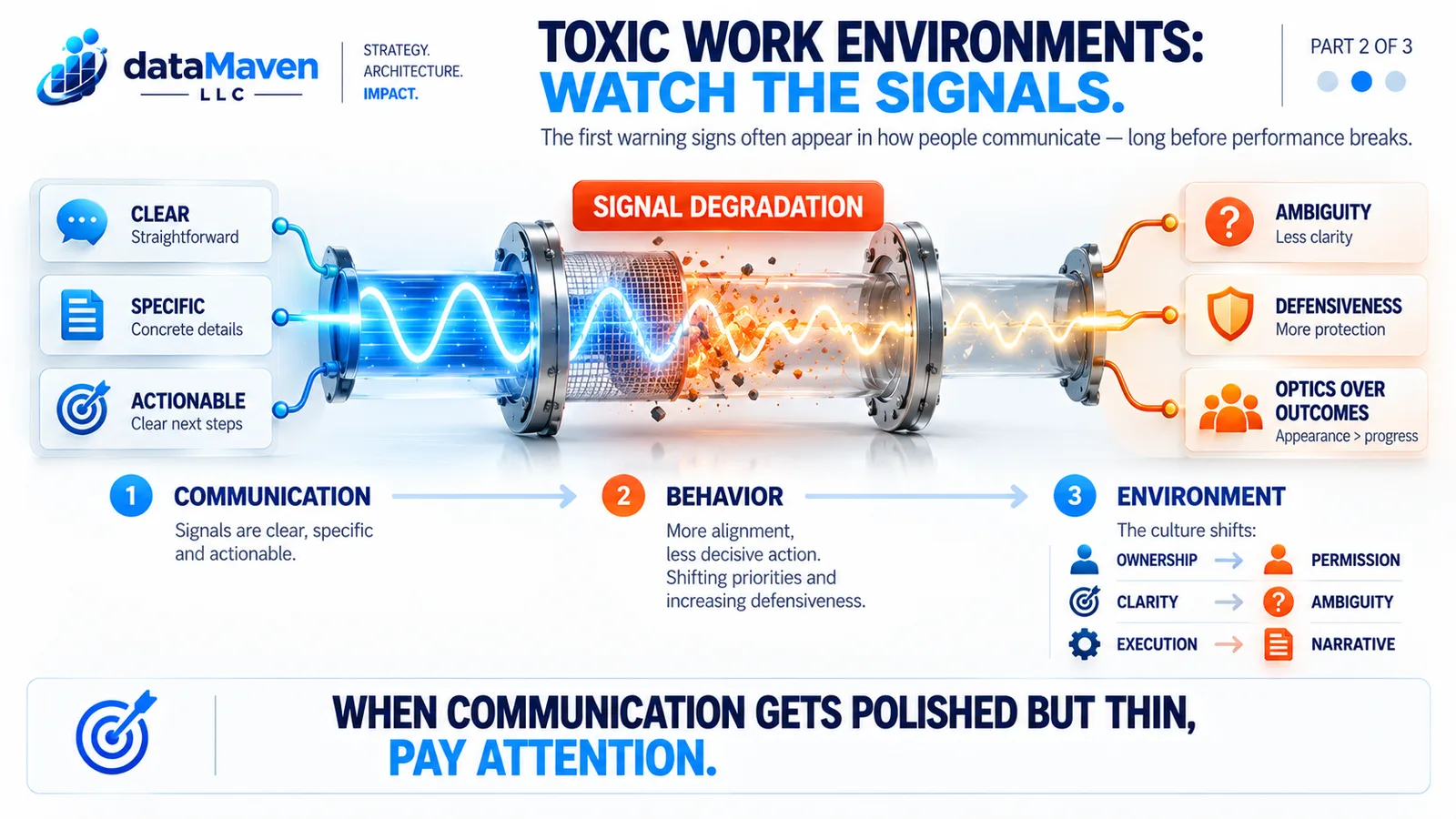
You rarely see the problem first in performance.
You see it in communication. Phrases that sound directionally correct — but lack specificity:
- “We need to work in lockstep”
- “It takes a village”
- “Let’s align on the baseline”
- “We should double-click into this”
- “Thank you for your leadership” — even when someone is simply doing their job
Individually, these are harmless. But repeated without context or follow-through, they start to replace clear thinking with generalized alignment.
Over time, communication becomes polished — but thin.
This isn’t intentional. It’s often a way to navigate uncertainty when understanding isn’t fully there.
Then behavior follows
- More alignment
- Less decisive action
- Shifting priorities
- Increasing defensiveness
Teams pick up on this quickly. High performers disengage first. Others adapt by optimizing for optics over outcomes.
And the environment shifts
- From ownership → permission
- From clarity → ambiguity
- From execution → narrative