
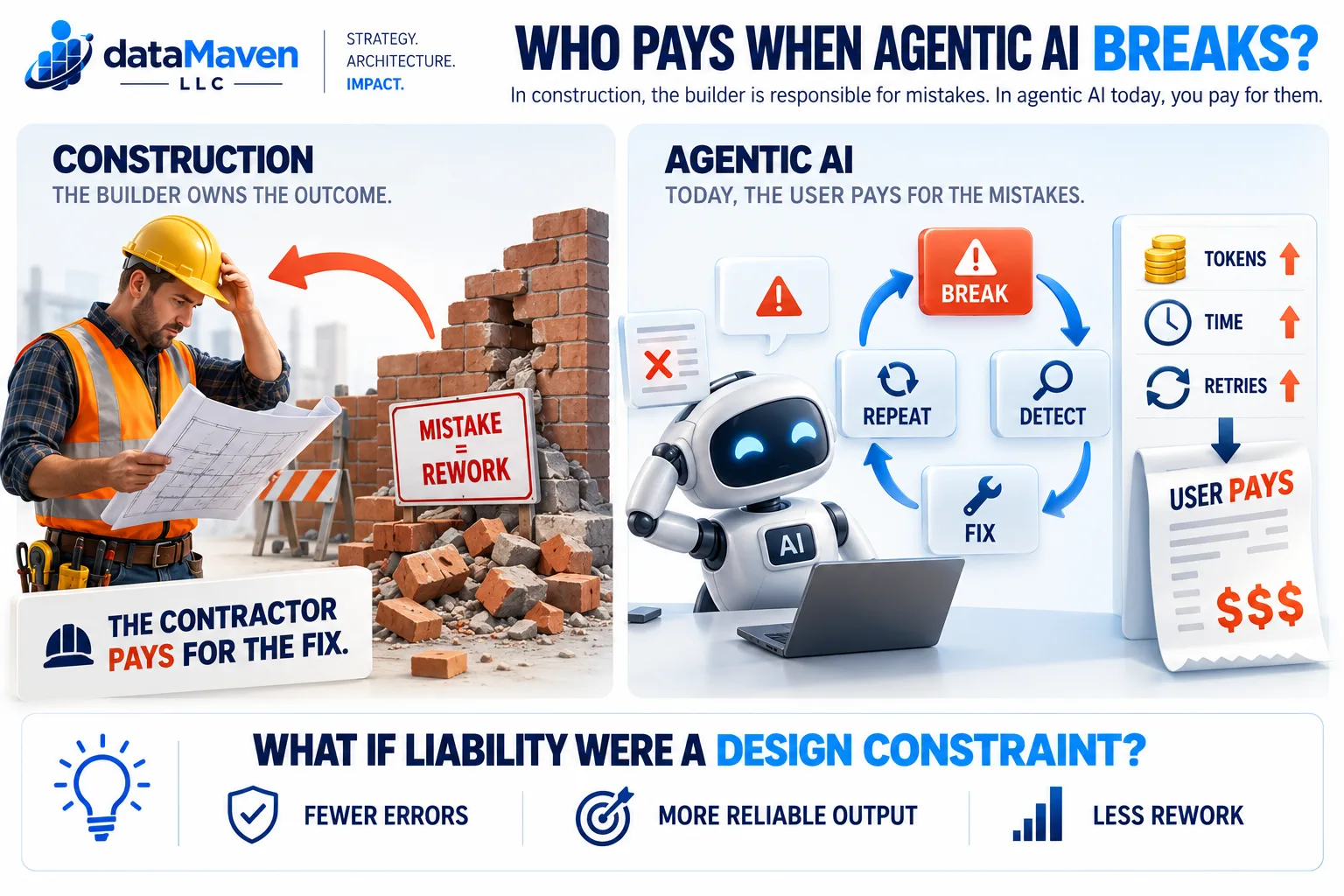
The other weekend I was helping on a remodeling project, running electrical wiring.
As I worked, I kept getting real-time feedback from the foreman:
- “Don’t waste wire — it’s expensive.”
- “Measure twice before you cut.”
- “If you mess it up, you’ll be the one fixing it.”
There was an implicit rule:
That got me thinking about how we’re using agentic AI today.
How agentic systems behave
Agentic systems:
- generate a lot of output
- make plenty of assumptions
- introduce errors (hallucinations)
- and then rely on humans (or more compute) to correct them
Every correction costs:
- tokens
- time
- retries
- more tokens
So we end up in a loop:
The economics
That’s a fantastic business model for AI providers. It’s a questionable one for users.
In construction, you don’t get paid for rework you caused — you absorb it. Sometimes years later, if defects surface.
In AI, it’s the opposite: the more errors produced, the more consumption increases.
What if liability were a design constraint?
Makes you wonder. What would happen if we introduced a concept of “liability” into AI systems?
- Fewer hallucinations by design?
- More constrained, reliable outputs?
- Less brute-force iteration?
I’m very bullish on agentic systems — but right now the ratio of output to rework feels off.
Maybe that’s just where we are. Or maybe… it’s not entirely accidental.
Curious how others are thinking about this.