
We all learned early on:
2 + 2 = 4
Simple. Certain. Undisputed.
But the moment you step into real-world systems, that certainty starts to… bend.
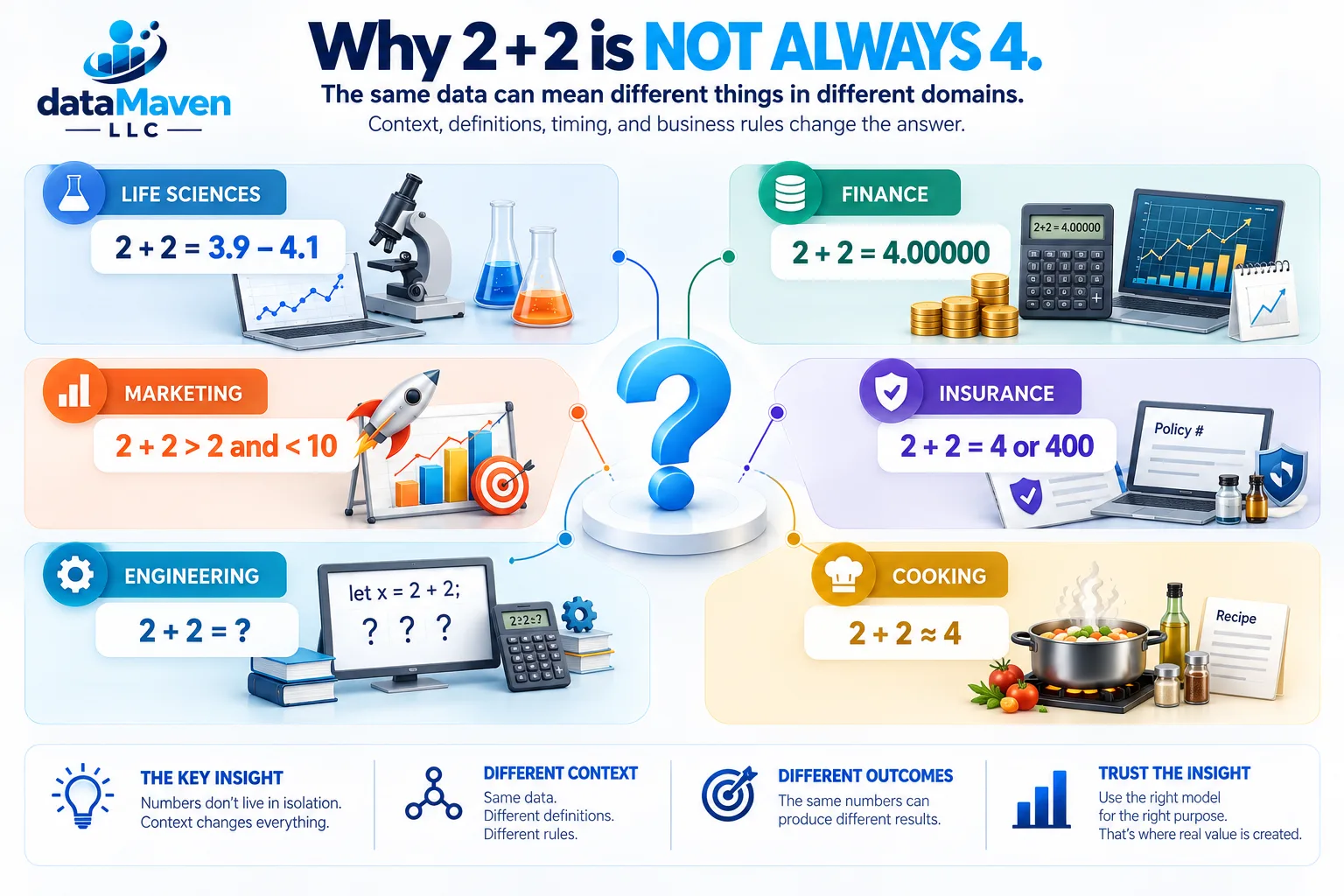
In life sciences
2 + 2 = between 3.9 and 4.1
…with a 95% confidence interval that it's probably 4.0.
In finance
2 + 2 = 4.00000
No rounding. No ambiguity. No excuses.
In marketing
2 + 2 = greater than 2 and less than 10
…and if the campaign worked, maybe closer to 12.
In engineering
2 + 2 = ?
"Wait… are these integers or floats?" "And which language are we using?"
In cooking
2 + 2 = about 4
Close enough. Adjust to taste.
In insurance
2 + 2 = 4
…but only if you read the small print. Otherwise it could just as well be 400.
So what's the point?
And that's exactly what happens in enterprise data systems.
We expect:
- consistency
- precision
- a single version of the truth
But in reality, data lives across:
- systems
- transformations
- interpretations
Each step introduces its own version of "2 + 2".
Precision is contextual
Some systems require absolute precision:
- financial reporting
- regulatory compliance
Others operate just fine with directional accuracy:
- dashboards
- forecasting
- experimentation
The problem isn't that different answers exist. The problem is:
- we often don’t know which version we’re looking at
- or what level of precision was intended
Where data systems really break down
That's where most data systems break down.
Not in storage, not in compute — but in context and clarity.
The real question
So the real question isn't:
"Why doesn't 2 + 2 equal 4?"
It's:
- Where in your system does it need to?
- And where does it not?
And more importantly: can you actually tell the difference?