Every board meeting today eventually arrives at the same question.
It sounds like a technology question. Most organizations answer it with conversations about models, copilots, vendors, or pilots.
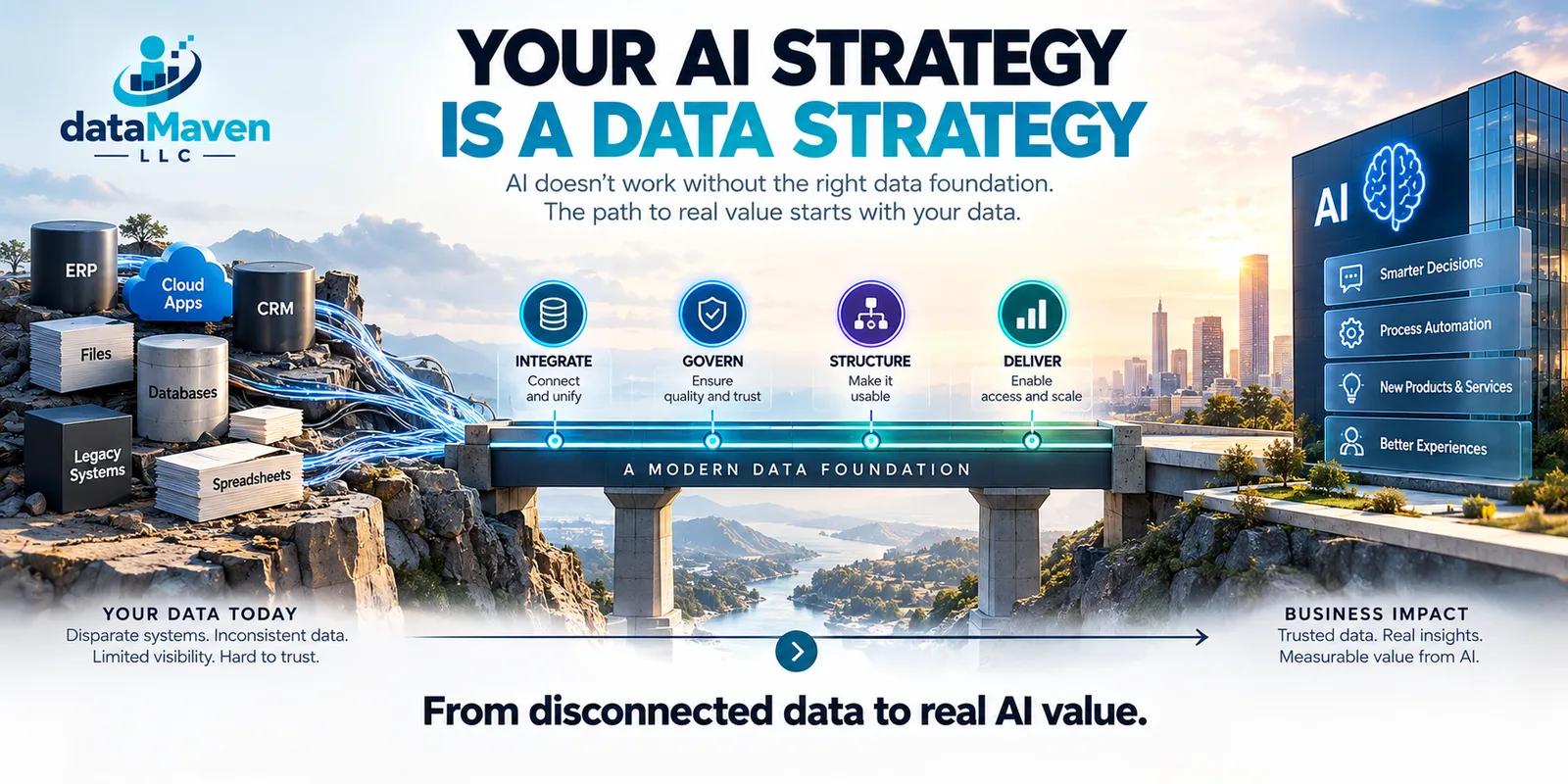
But after spending the last few months assessing a large global manufacturing organization, I came away with a very different conclusion. For most companies, the honest answer is much simpler:
Not because they don’t have enough data. Because the way their data is organized reflects twenty years of incremental decisions — not a deliberate enterprise strategy.
AI amplifies your foundation — it doesn’t fix it
This is the idea the whole thing revolves around:
- If your data is fragmented, AI amplifies fragmentation.
- If ownership is unclear, AI amplifies inconsistency.
- If business definitions differ, AI produces conflicting answers faster.
The three levels of AI maturity
“AI-ready” and “not ready” is the wrong framing. It’s more useful to think in levels — because most organizations are further along than they fear on the first two, and further behind than they think on the third.
Level 1 — AI Experimentation
- ChatGPT
- Copilots
- Individual productivity
Everyone can start here.
Level 2 — AI-Assisted Business
- Internal documents
- Knowledge search
- Meeting summaries
- Code generation
Still manageable.
Level 3 — Enterprise AI
Now everything changes. You need:
- Trusted data
- Governed access
- Enterprise definitions
- Lineage
- Metadata
- Ownership
This is where most companies discover they’re not as ready as they thought.
AI is exposing architectural debt
For years, organizations were able to compensate for complexity through talented people, manual processes, and operational excellence. AI changes that.
Large language models don’t understand your organization. They understand the data you provide.
I wrote earlier about why enterprise stacks grow tightly coupled and frozen in time. This is what that coupling actually costs you the moment AI enters the room.
What “ready” actually looks like
AI-ready organizations tend to share a few characteristics. Read them closely — none of them mention AI.
Data is portable. Business information isn’t locked inside one application.
Business concepts are defined once. A customer means the same thing everywhere. Revenue means the same thing everywhere.
Operational systems are separated from reporting. Replacing an ERP doesn’t break every dashboard.
Ownership is clear. Someone owns the data. Someone owns the definition. Someone owns the quality.
Architecture has a direction. Technology decisions are guided by principles rather than individual projects.
Notice that none of those points mention AI. That’s the point.
Defining Enterprise AI Readiness
So instead of the vague “AI readiness,” let’s define it precisely:
That’s a definition you can actually hold a strategy against.
Final thought
The organizations that will benefit most from AI won’t necessarily be the ones using the newest models. They’ll be the ones that spent the time building an enterprise architecture capable of supporting them.
Because AI strategies will change. Models will change. Vendors will change.
But organizations with clear architecture, governed data, and portable business information will be able to adopt those changes far faster than organizations still trying to untangle decades of accumulated complexity.